Enterprise Dashboard Experience
Turning a Mandatory Task into a Powerful Business Tool that Drives Operational Insights Across 60,000+ Locations Globally
INDUSTRY
Enterprise: Multi-brand Franchise
Role
Lead User Experience Designer
Team
Cross-functional team working in agile sprints
Tools
Figma, FigJam, Miro, Trello
Contributions
UX Research, Product Strategy, Visual Design, Design System Management, Led Stakeholder Presentations
ENVIRONMENT
Agile Enterprise
Overview
This project supported a global franchise enterprise operating 60,000+ locations across 150+ countries, generating more than $65B in systemwide sales. Corporate relied on a centralized analytics portal to collect and monitor franchisee financial performance at scale. The problem wasn't access to data, it was adoption. Franchisees saw the platform as a reporting obligation rather than a business tool. Usage was inconsistent, data entry was incomplete, and the insights corporate relied on were often skewed as a result. Our task was to reimagine the platform so it delivered clear operational value for franchisees while still meeting corporate reporting needs.
Goal
Identify why adoption of the enterprise analytics platform was low and redesign the experience so franchisees could quickly understand performance, explore insights, and engage with the system beyond required reporting.
Because this work was completed under a non-disclosure agreement, company names and identifying details have been generalized. This case study focuses on the research and design thinking that shaped the recommendations.
Understanding Why Adoption Failed
The platform wasn't broken. It connected thousands of franchise operators to corporate reporting infrastructure across 150 countries. Data flowed in. Dashboards existed. Features had been built. But when we started asking operators how they actually used it, a pattern emerged fast: they didn't. Not really. They logged in when a quarterly deadline forced them to, uploaded what was required, and left. The system had been designed to collect data. Not to give anything back.
For corporate, this created a quiet crisis. The insights they depended on to make decisions at global scale were only as good as the data coming in. And that data was inconsistent, incomplete, and increasingly unreliable. Not because operators were negligent, but because the platform gave them no reason to care.
Going Directly To The People Who Weren't Using It
We conducted dozens of interviews with franchisees and corporate stakeholders, walked through real reporting workflows, and observed how both groups navigated the system in practice. Given the volume of qualitative data we needed to synthesize, we used AI-assisted analysis tools to surface recurring patterns, freeing the team to focus on interpreting what those patterns meant rather than manually sorting through transcripts.
What The Research Told Us
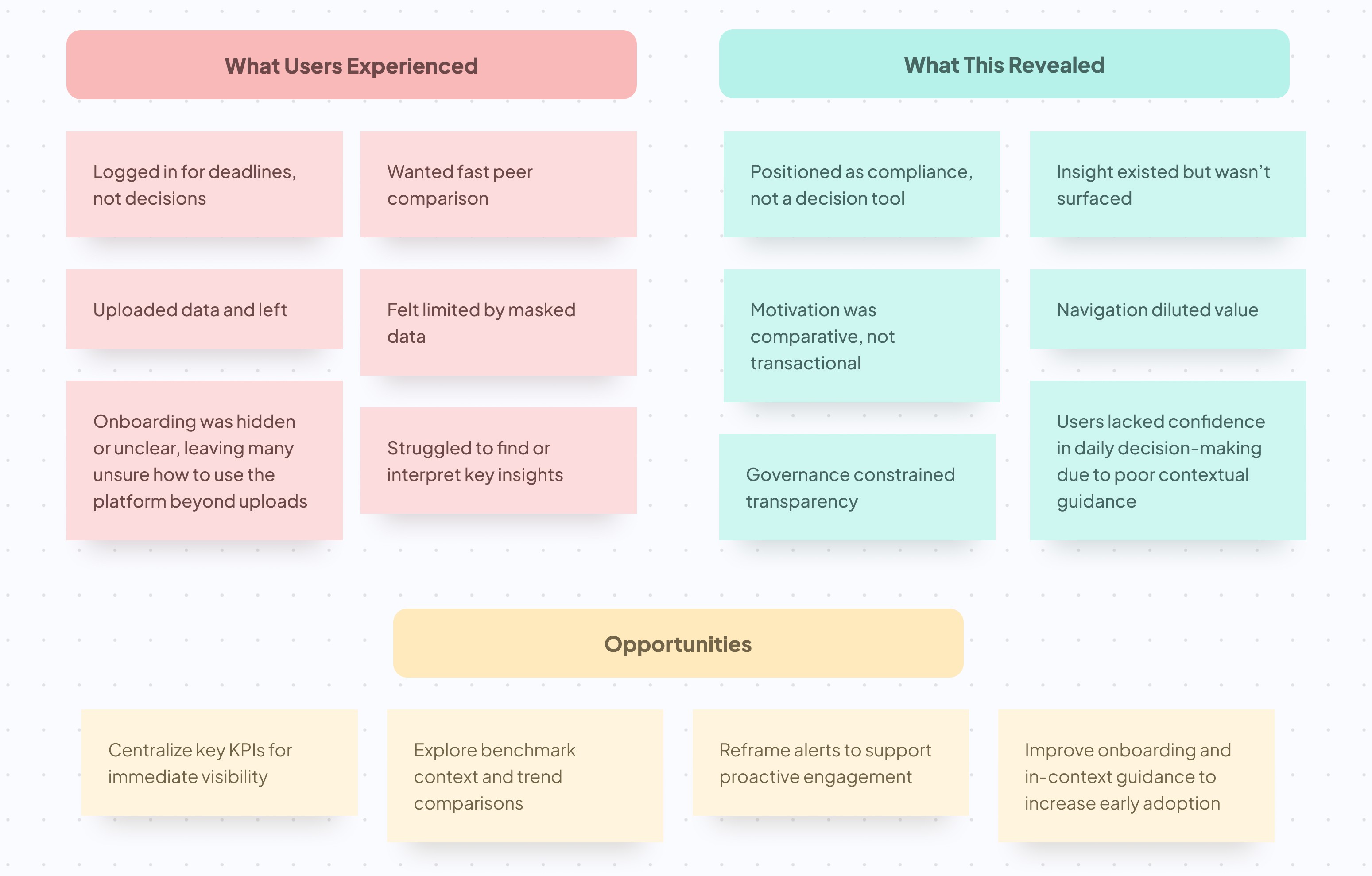
We conducted dozens of interviews with franchisees and corporate stakeholders, walked through real reporting workflows, and observed how both groups navigated the system in practice. The interviews were consistent. Regardless of market, location size, or operator experience, the same frustrations surfaced again and again. Three structural problems were driving the disconnect.
FINDING 1: VALUE MISMATCH
The platform existed to serve corporate reporting needs. It delivered almost nothing of operational value to the franchisees completing that reporting. Operators logging in to understand their own performance were met with dense tables, dated visuals, and filtering tools that required significant effort just to interpret, let alone act on.
FINDING 2: NAVIGATION FRICTION
System walkthroughs revealed a complicated navigation structure with no central dashboard. Users had to click through multiple pages to reach basic metrics. Onboarding was buried deep within the system. Many operators told us they had figured out how to upload their required data. Nothing else.
FINDING 3: CONSTRAINED TRANSPARENCY
Benchmarking, one of the platform's most genuinely valuable capabilities, was significantly limited by data masking designed to protect trust between franchisees. The result was a feature that existed in name but couldn't deliver meaningful competitive insight.
We Had Answered Why. Now We Needed to Answer How.
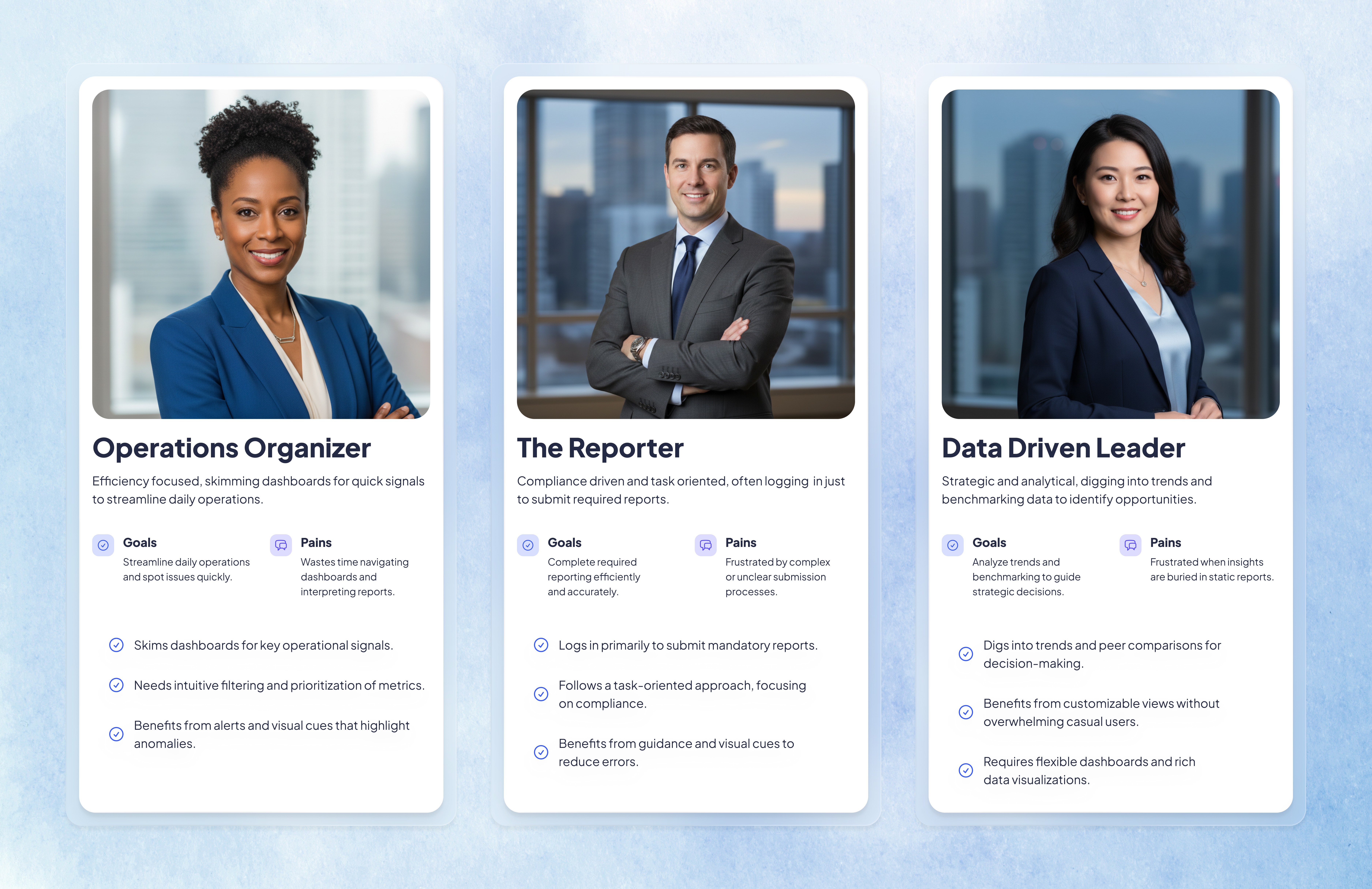
We synthesized research findings into three personas representing distinct operator profiles and corporate roles. From this foundation, we aligned around three design priorities: surface insights faster, reduce friction in exploration, and modernize the experience without disrupting a global user base already familiar with the system.
Where The Work Happened
We Gave the Platform a Front Door
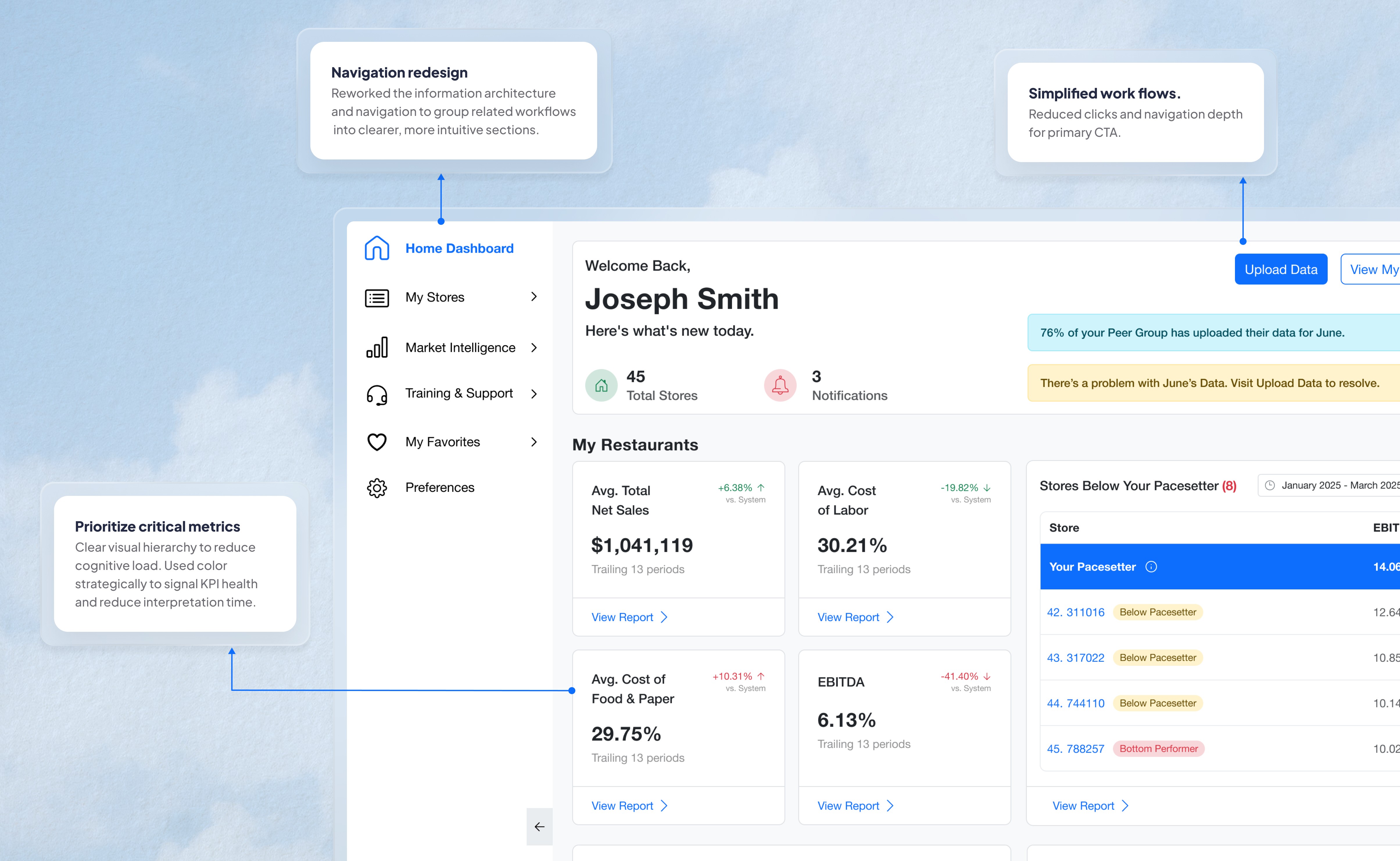
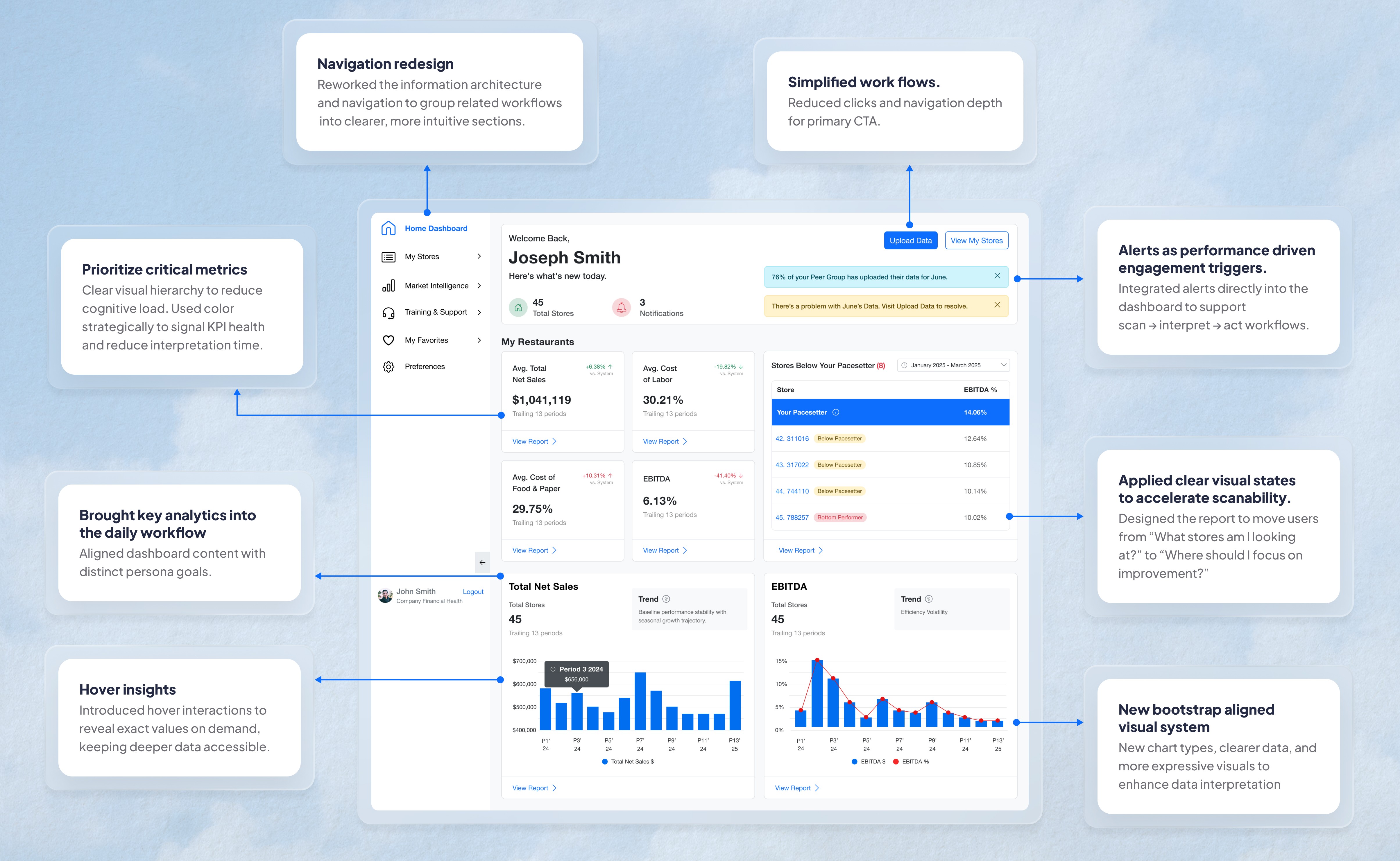
The most significant gap in the original experience was the absence of any central starting point. We introduced a home dashboard that surfaced key KPIs, benchmark comparisons, and clear calls to action. Operators could open the platform and immediately see what mattered. This dashboard also became the anchor for a reusable component system, giving engineering a consistent set of patterns to build from as the product evolved.
Navigation Rebuilt Around Real Workflows
We restructured the information architecture around real workflows: consolidating related tasks, adding contextual sub-navigation, and eliminating unnecessary transitions. The result was a system that required meaningfully fewer steps to reach the information operators needed.
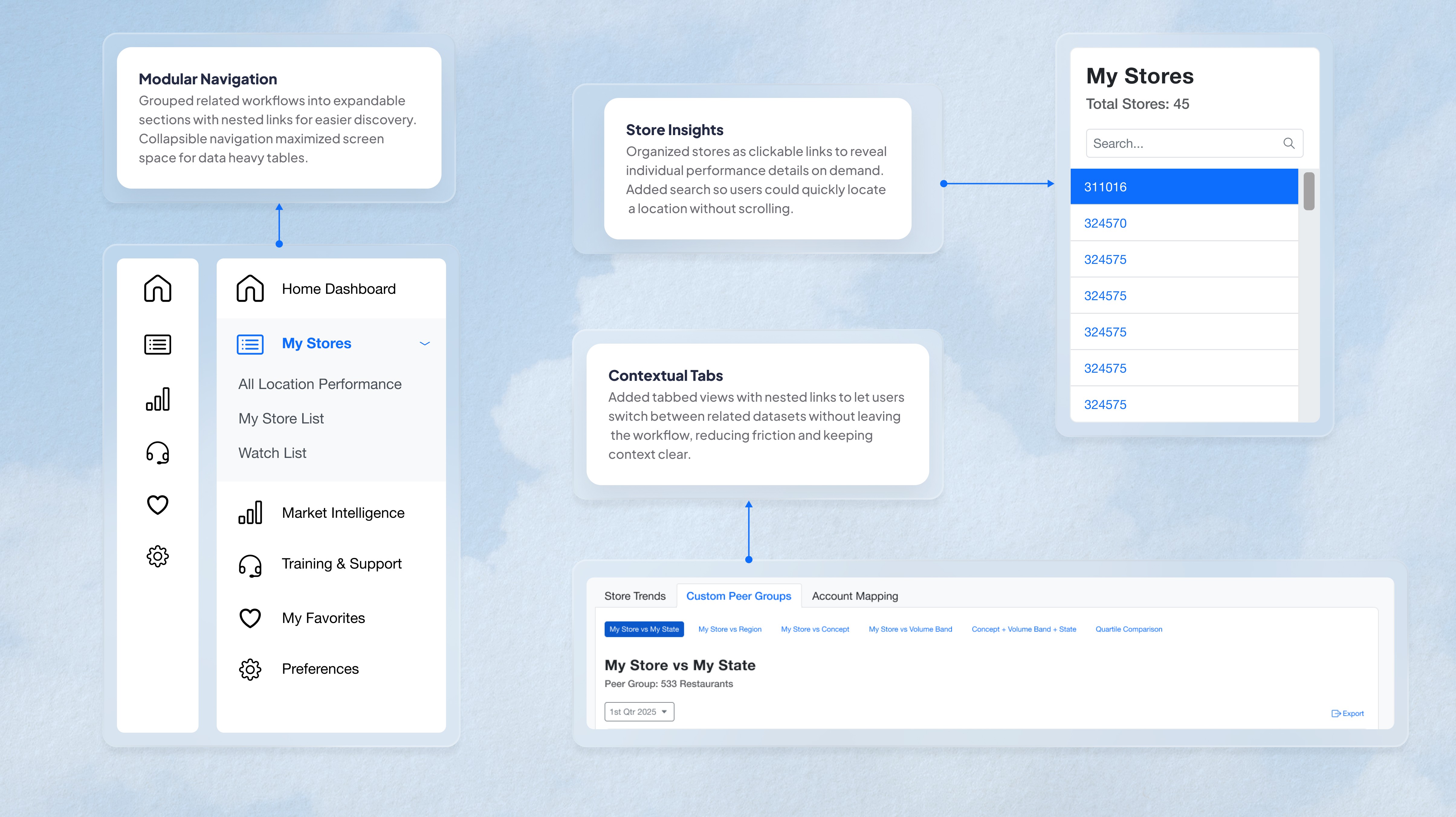
Making Data Easier To Read At A Glance
We refined typography, spacing, and chart styling to reduce cognitive load and improve scannability. Semantic color cues were introduced to highlight performance thresholds and flag items requiring attention.
Filtering Without Interruption
Filter controls had been hidden inside a modal pop-up that interrupted the workflow. We repositioned them directly within the layout with clearer hierarchy, allowing users to adjust views quickly without losing their place in the data.
Designing Within Real Constraints
Every concept was pressure-tested with engineering early. Rather than proposing idealized solutions, we focused on improvements that would deliver meaningful impact within what the system could realistically support.
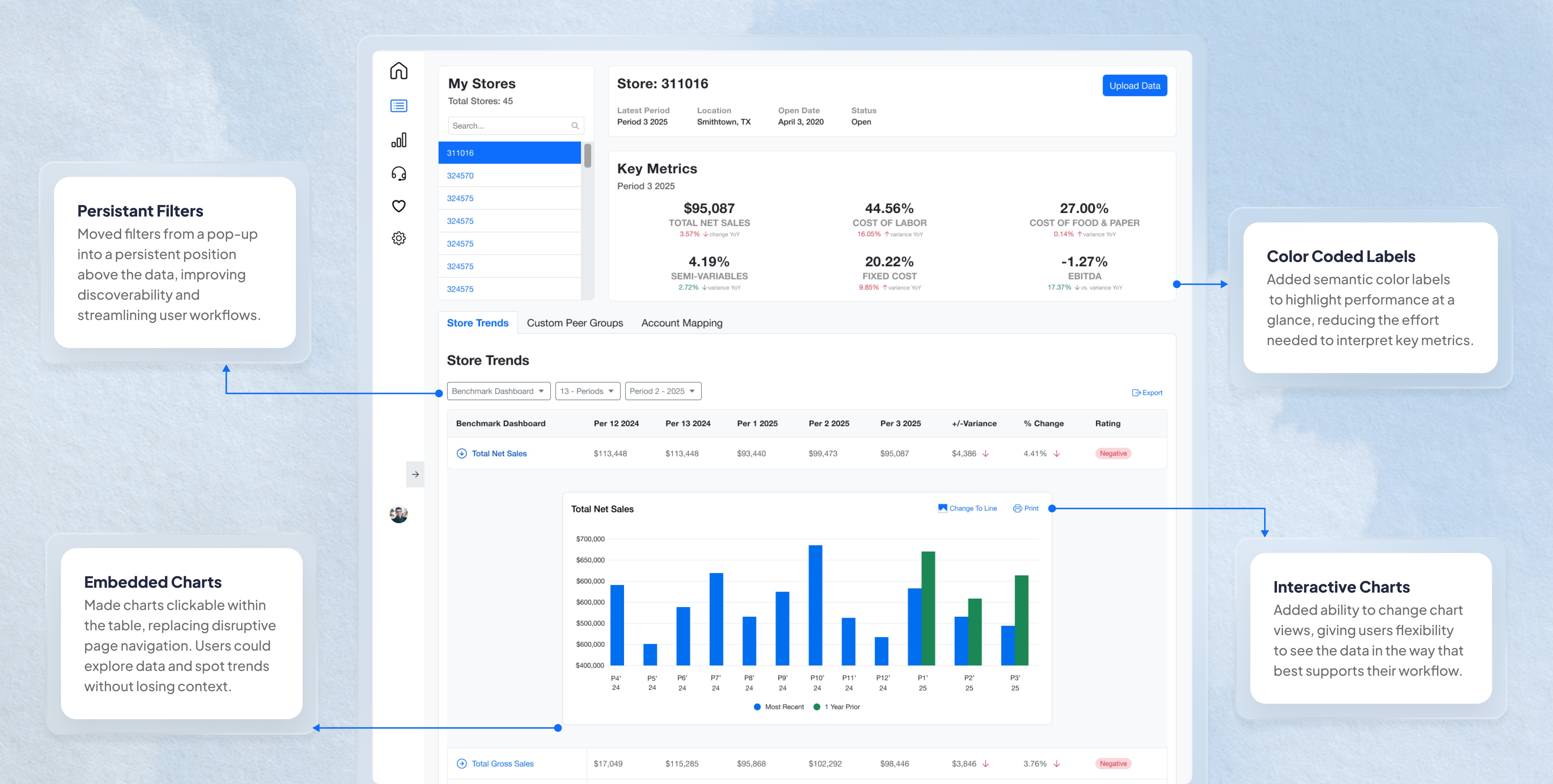
Reframing What The Platform Could Be
This phase of work gave the organization a clear, research-grounded understanding of why the platform wasn't working and a validated direction for fixing it. The product roadmap shifted toward phased improvements that balanced usability, operational trust, and scale.
The work reframed the platform's identity. Not as a reporting requirement imposed on franchise operators. As an operational resource that could support the decisions they were already making every day.

What This Work Reinforced
Adoption problems rarely come from a lack of features. The real issue was that the experience didn't support how franchisees actually made decisions. It reinforced the importance of designing for the user's motivation, not just the system's purpose. Enterprise systems often sit on shared architecture that can't be easily rewritten, so focusing on improvements that create meaningful change without destabilizing the platform matters. The most impactful progress came when insights, technical realities, and business priorities were all part of the same conversation.
My Contributions
Contributed to research synthesis and insight development across dozens of franchisee and stakeholder interviews
Designed end-to-end platform workflows and restructured the information architecture
Created high-fidelity wireframes and interactive prototypes for stakeholder validation
Collaborated closely with engineering to scope design decisions within system constraints
Presented design strategy and solutions to corporate stakeholders